By the time dust removal reaches a purchase request, the choice usually comes down to compressed air through nozzles, a regenerative blower, or a centrifugal blower feeding an air knife or nozzle array. Any of them can clear a part on a good day.
Where they split is running cost, how they handle dust that clings instead of lifting, and what maintenance looks like two years in. The best air blower for dust removal is the one whose weaknesses your line can live with.
For a production line operating every shift, that is usually a direct drive blower selected for air volume and feeding an air knife, with cannon nozzles or ionization added where the contamination requires them. Compressed air and regenerative blowers both have applications they handle well, but those applications are narrower.
Which one fits your facility depends less on the blower than on the particulate itself: what material it is, what holds it to the surface, and where on the part it accumulates.
Choosing an Air Blower for Dust Removal Starts with the Dust
Particulate on a production line usually arrives in more than one form, and each form responds to moving air differently.
Loose, dry dust on a flat surface is the easy case. A broad, uniform sheet of air carries it away, and almost any air source with sufficient volume behind it can produce that sheet.
Electrostatically charged dust is more difficult. Plastics, painted panels, and many composite materials hold a static charge that pins particles to the surface, so air alone tends to move them a short distance before they resettle. That contamination needs ionization delivered in the same air stream. AF1 air knives can carry the ionizing bar inside the knife, which puts the neutralizing air and the blow-off air on the part together.
The third category collects in recesses, threaded holes, and blind cavities. A flat air sheet passes over those openings without disturbing the particulate inside them, so clearing them requires concentrated airflow directed into the geometry, which is the application air cannon nozzles are designed for.
Many production lines have more than one of these categories on the same part. A station engineered around one category will leave the others where they were, so identify which categories your parts actually carry before comparing blowers.
Why Compressed Air Costs the Most to Operate
Compressed air is the default because the distribution piping is already installed. A drop runs to the station, a blow gun or a few nozzles go on the end, and the contamination problem appears solved for the price of a fitting. The operating cost accumulates on the electricity bill, where nothing connects it back to the station.
Compressed air can cost seven to eight times more than blower-driven air delivering equivalent blow-off performance. Most of the electricity a compressor consumes leaves as heat before any air reaches a nozzle, and leak surveys commonly find 20 to 30 percent of a compressor's output escaping before it accomplishes anything useful. A dust removal station operating open nozzles across two shifts pays for both losses the entire time the valve is open.
Handheld blow guns are also a safety problem. The pressure that removes particulate from a part can drive particles into the eyes, ears, or skin of anyone nearby, and several Canadian jurisdictions limit cleaning nozzle pressure to considerably less than a plant airline delivers. A fixed station directs the air at the part and keeps operators out of its path.
None of that eliminates compressed air as an option. A station operating a few minutes a day won't consume enough air to justify new equipment, and a blow gun at a rework bench is a different application from open nozzles over a conveyor.
What a Pressure Rating Tells You About Dust Removal
Blower specification sheets lead with pressure, and pressure is easy to compare between quotations. For blow-off applications, it's the wrong number to buy on. Most of the work is done by air volume, and pressure and volume trade against each other, so a blower configured for higher pressure delivers less air.
On a dust removal station, that trade appears as coverage. A narrow, high-pressure stream hits one band of the part hard and leaves the adjacent surface untouched, while a higher-volume stream at moderate pressure carries enough air across the full width of the part to lift particulate wherever it has settled.
High pressure does have legitimate applications, such as moving air through extended duct runs or dense filtration media. An open conveyor carrying parts past a dust removal station is rarely one of them.
Where Regenerative Blowers Fit, And Where They Run Short
Regenerative blowers are a common upgrade from compressed air. They're compact, and they generate useful pressure from a small package, which suits a single nozzle or a short air knife cleaning a small part.
Their limitation appears when the application gets wider. Removing particulate across a full conveyor or a large panel requires more air volume than a regenerative unit comfortably supplies. The usual response is installing a second unit, which leaves two motors consuming electricity and two blowers requiring maintenance where one larger blower would have covered the width.
Regenerative blowers also tend to be loud without silencers, a consideration on any line where operators work beside the station for an entire shift.
Why Direct Drive Blowers Hold Up on Dusty Lines
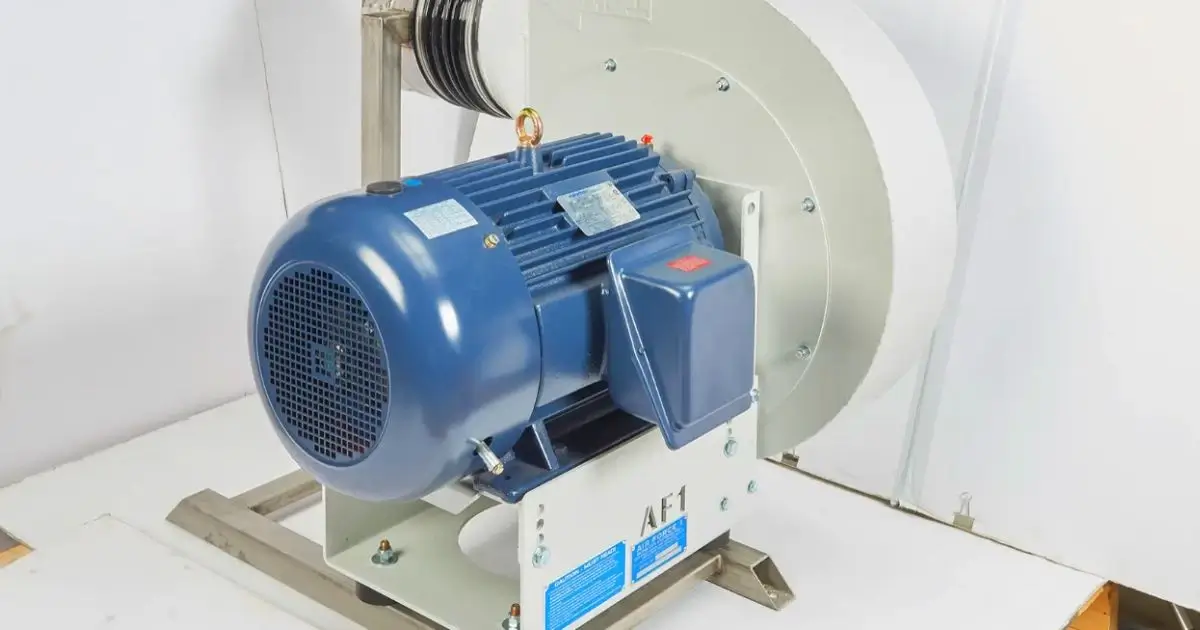
For most factory dust removal, the blower that fits is a direct drive unit selected for volume. In a direct drive blower system, the impeller mounts directly on the motor shaft, and with no belts or additional bearings in the drive, there is less to wear and nothing to re-tension.
Belts are the vulnerable point on a dusty production line. They stretch and slip as they wear, so blower output declines gradually instead of failing outright. A gradual decline is difficult to notice at the station itself, and it can appear as contaminated parts at the next process before anyone inspects the drive.
Direct drive also loses no energy through a belt, and it operates more quietly than a belt-driven blower. We manufacture direct drive blowers in low- and high-pressure models, with non-sparking and corrosion-resistant construction available for facilities where airborne particulate is combustible, or the station is regularly washed down.
A direct drive blower still has limitations you should plan for. It moves whatever air surrounds it, so a blower drawing from a dusty area requires inlet filtration, and that filter becomes the maintenance item that replaces the belt. A blower delivering enough air for a wide conveyor is not quiet either, which is why we build sound enclosures and inline silencers, and why they belong in the original quotation instead of being added after the first noise complaint.
Line speed is the other variable to settle early. If the same station handles large panels on one production run and small brackets on the next, a variable frequency drive lets the blower's output follow the line, so it isn't operating at full capacity for parts that need a fraction of the air.
Surface Dust Removal Before Painting Leaves the Least Margin
Surface dust removal before painting is where an inadequate station costs the most. A particle trapped beneath the topcoat becomes an inclusion, and the part goes to rework or scrap after the paint and booth time have already been spent on it.
Pre-paint stations also tend to encounter every category of particulate at once. Sanding and handling leave loose dust; the substrate often carries an electrostatic charge and formed edges trap particles in corners. Dust contamination on production line fixtures and racks travels into the booth with the part. A station that clears only the flat surfaces can look acceptable at a glance and still send inclusions through.
That combination is why the blower and the nozzles for a pre-paint station have to be specified together. A high-volume blower feeding an air knife clears the primary surfaces; cannon nozzles reach the recessed areas, and ionization in the same air stream prevents particulate from resettling between the station and the booth.
Blower vs Compressed Air for Dust Removal: Which Fits Your Line
The blower vs compressed air for dust removal decision mostly comes down to operating hours. A station operating every shift pays the compressed air premium the entire time it runs. Payback on a blower system typically falls between a few months and a couple of years, depending on operating hours, energy rates, and your current compressed air costs.
Once the operating hours justify a blower, the part geometry and the particulate determine the rest:
Occasional use, a few minutes a day: compressed air is usually adequate.
One small part or a narrow target: a regenerative blower can handle it.
A full conveyor width or large panels, every shift: a direct drive blower selected for volume, feeding an air knife.
Charged particulate on plastic or painted parts: ionization in the same air stream.
Recesses, threaded holes, or blind cavities: air cannon nozzles alongside the knife.
Most stations fall under more than one line of that list. AF1 builds dust and particulate removal systems from direct drive blowers, air knives, and cannon nozzles, with static control where the contamination requires it.
If dust is still reaching your paint booth or packaging line after the blow off station, contact us. We can evaluate what the particulate is, where it accumulates on your parts, and what your current air source is removing.


