Compressed air knives are the right choice in more places than a blower manufacturer is usually willing to say. A short knife that fires for a second when a part trips a sensor, on a machine with no room for a blower, is a good use of compressed air.
The trouble starts when that same logic gets stretched to a knife running continuously across a wide conveyor for two shifts a day. The blower air knife vs compressed air knife decision turns on how long the air runs, not on which technology is better.
In continuous-duty applications, the blower knife wins, and its advantage increases with every additional production shift. Compressed air still has applications it handles well, and recognizing where those applications end is what keeps a facility from paying compressor prices for work a blower performs more economically.
Where a Compressed Air Knife Still Makes Sense
A knife that fires only when a part interrupts a photoelectric sensor consumes air for a fraction of each machine cycle and none in between. On compact equipment with no floor space for a blower and no practical route for ductwork, a short compressed air knife connected to an existing drop is often the only configuration that physically fits.
It is also inexpensive to install. The knife itself costs relatively little, and when the distribution header already passes the station, there is almost no additional infrastructure to purchase. For intermittent duty of a few seconds per minute, the compressed air consumed rarely approaches the purchase price of a blower, so compressed air is a reasonable specification there, and nobody should talk you out of it.
A station can leave that category without anyone purchasing new equipment. Conveyor speed increases; production adds a second shift, or the sensor fails, and the solenoid valve gets wired permanently open. The knife is the same one that was originally a sensible purchase, but it is now performing a continuous-duty application on an intermittent-duty budget.
Why High Compressed Air Costs Rarely Get Charged to the Knife
The operating cost of a compressed air knife is determined in the compressor room. Electricity enters the compressor, most of it is rejected as heat of compression, and a small fraction reaches the knife as usable airflow. It takes about 10 units of electrical energy to produce one unit of useful work from compressed air. That conversion loss is inherent in compression itself, so improved compressor maintenance does not eliminate it.
For blow-off applications, compressed air can cost seven to eight times more than blower-driven air performing equivalent work. The facility pays that difference inside a single electricity bill shared by every pneumatic tool, cylinder, and nozzle on the system, so the knife consuming a substantial portion of the air never carries the expense on its own departmental budget.
The capital expenditure request for a new drying station has the same limitation. It compares the purchase price of a compressed air knife against the purchase price of a blower package, and the compressor's electrical consumption does not appear anywhere in the comparison. The quotation therefore favors compressed air nearly every time. Evaluate the two alternatives by annual operating hours on a continuous production line, and the result usually reverses.
Leaks, Pressure Drop, and the Regulator Nobody Turns Back Down
A compressed air knife draws from a distribution system that is already losing air. Industrial facilities commonly lose 20 to 30 percent of compressor output through leakage at fittings, quick-disconnect couplings, and deteriorated hoses. The air delivered to the knife is generated alongside air that never arrives, and the compressor consumes electricity producing both.
Header pressure is the next constraint. A long knife in continuous operation has a high flow demand, and when other stations draw simultaneously, pressure at the knife decreases, and parts leave the station wet. An operator or maintenance technician then raises the system pressure setpoint or opens the knife's regulator, which restores drying performance and increases compressor energy consumption for every other pneumatic application in the facility.
If maintenance has raised header pressure to keep a drying station functioning, that station has outgrown compressed air.
Compressor capacity is the most expensive consequence. Each continuous knife occupies capacity that other production equipment was depending on, and after enough additions, the facility is evaluating an additional compressor to supply stations that never required compressed air.
Blower Air Knife vs Compressed Air Knife on a Continuous Line
Drying and clean-up both appear on the standard list of inappropriate uses of compressed air, with low-pressure blowers identified as the alternative. Duty cycle is the reason. A knife operating every minute the production line operates absorbs the compressor's conversion losses for every one of those minutes.
A blower-powered air knife system generates its own air at the point of use. It draws nothing from the header and is unaffected by leakage in the facility's distribution piping. Blower air also costs considerably less per cubic foot to produce, and a larger volume of air at lower pressure frequently dries and cleans more effectively than a narrow, high-pressure jet.
Lower pressure does not mean lower velocity. AF1's blower-driven air knives are capable of producing over 20,000 fpm, which addresses the common objection that blower air is too gentle for high-speed production.
Air knife drying for packaging lines is the clearest example. Bottles and cans leave the rinser or filler wet, pass the knife at full production speed, and continue to labeling or coding. Moisture remaining on a container shoulder or inside a can dome becomes a label that will not adhere or an inkjet code that smears. That knife operates for the entire shift, which is precisely the duty cycle where compressed air is most expensive.
Food, beverage, and pharmaceutical packaging lines have a contamination consideration as well. Lubricated compressors can carry oil aerosol downstream, and aging distribution piping can release corrosion and scale. A compressed air knife installed above open containers depends on the upstream filtration and air dryers being maintained on schedule, whereas blower air never travels through the facility's distribution piping.
What a Blower System Asks of You
A blower knife costs more to purchase than a compressed air knife of equivalent length. The blower requires floor or mounting space near the station, and the air must reach the knife through ductwork or flexible hose. On a congested machine frame, locating that space can be the most difficult part of the installation.
Maintenance requirements are lighter than most engineers anticipate. A direct drive blower has no belts requiring tension adjustment or replacement, and the knife itself contains no moving parts. A compressed air knife depends on the compressor, refrigerated or desiccant dryers, filters, condensate drains, and the interconnecting piping, and those maintenance costs are rarely allocated to the blow-off station generating the demand.
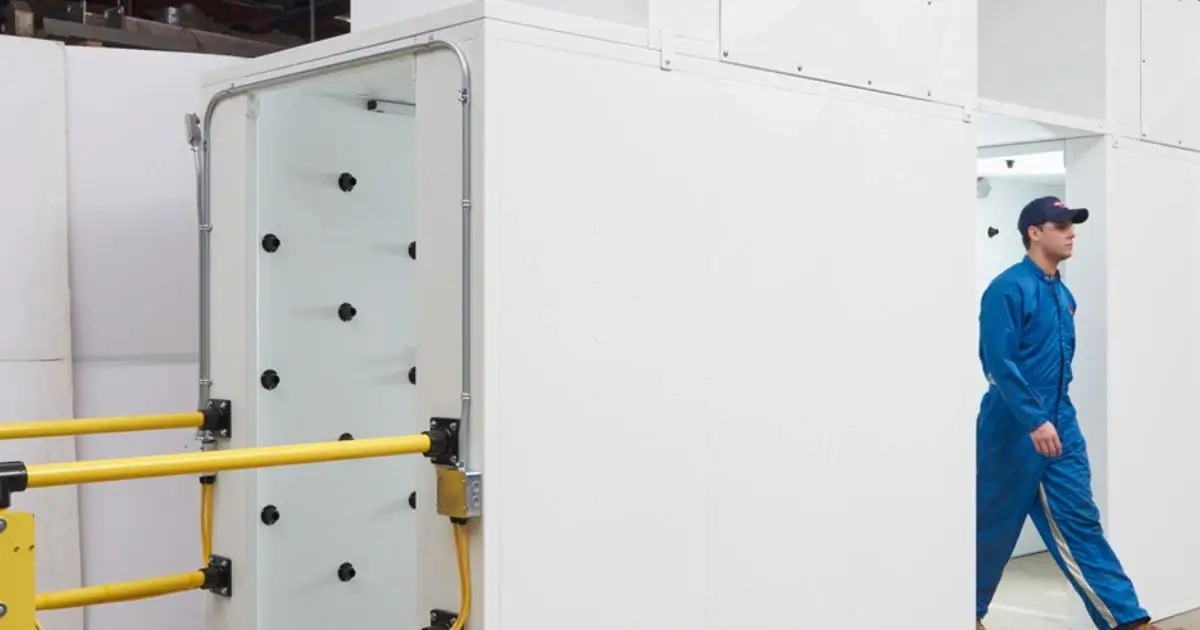
Address noise before the blower is installed. AF1 manufactures sound enclosures and inline silencers as part of its systems, so a blower located near operators can be attenuated in the original design and not after the first complaint.
Questions That Settle Which Knife Your Line Needs
A few operating facts about the line usually determine the decision.
How many minutes per hour does the knife operate? Measure the time air is actually flowing, not the time production is scheduled. A knife that fires on a sensor for one second per part is a different application from one that discharges through every gap between parts.
How many shifts does the line operate? Annual operating hours are what convert a low purchase price into a high yearly electricity expense.
How close the compressor is to its rated capacity. If another knife requires another compressor, the comparison is over.
Whether space is available near the station for a blower and its ductwork. If it is not, a short compressed air knife may be the only option, and the priority becomes confirming that it shuts off between parts.
Payback on a blower-powered knife varies from several months to a couple of years. It depends on operating hours, electricity rates, and what your compressed air currently costs to generate, and it shortens as annual operating hours increase.
Converting every station is not necessary to capture most of the savings. The knives in continuous operation consume most of the blow-off air, so those are the stations to convert to a blower, and the short, sensor-triggered knives can remain on compressed air.
Whichever technology you select, the knife should discharge only when a part is present. A compressed air knife left operating between parts and through scheduled breaks becomes a continuous-duty knife without anyone deciding it should be.
Where the Answer Usually Lands
For a knife that fires briefly on a sensor, compressed air is usually the appropriate choice, and converting it to a blower will not pay back. For an industrial air knife system operating continuously across a conveyor, the blower knife has a lower operating cost, leaves header pressure undisturbed, and frequently dries more effectively at production speed. Each additional shift widens the difference.
Most facilities have both categories of station on the same header. Classify them by duty cycle first, because the continuous stations are where the compressor's electricity is being consumed.
If you have a compressed air knife running full shifts on a drying or blow-off station, contact us. We will review the duty cycle and tell you whether a blower-powered air knife system would pay back on your line.


