
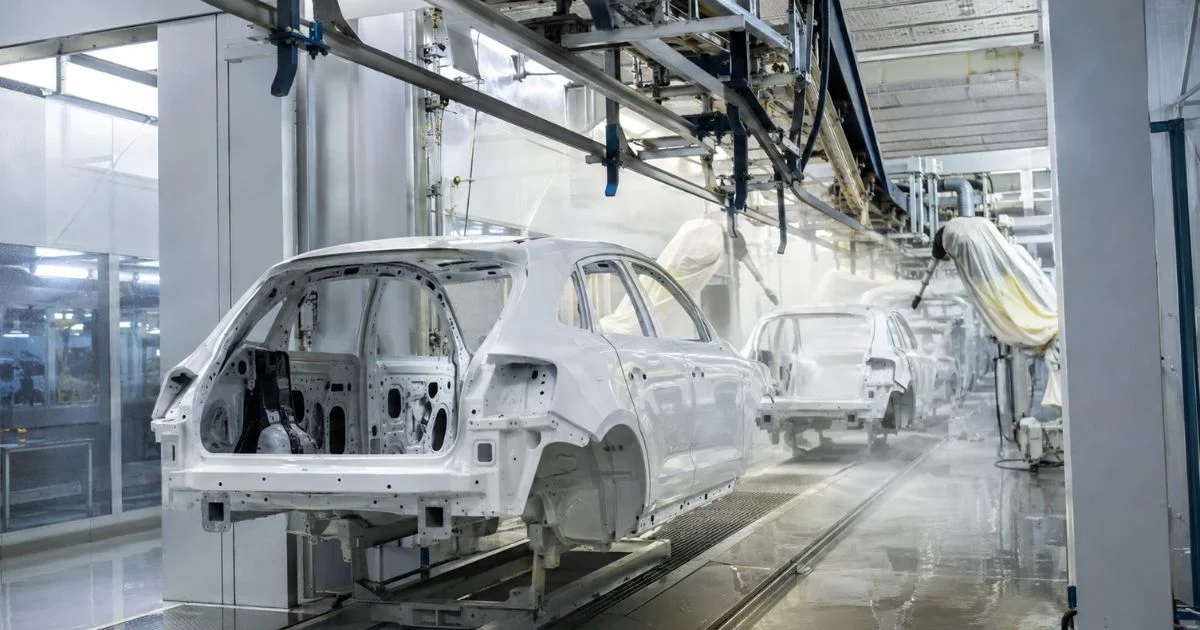
Rust complaints land on the paint department first. Blisters under the topcoat and creep along part edges point toward surface preparation, so that is where the investigation starts. Preparation is rarely the problem.
The water feeding that corrosion was in the part before preparation touched it. It sat in a geometry the drying station never reached. Correcting the wrong station is the expensive part.
Three mistakes account for most air knife drying system failures. None of them look like failures on the production floor.
Why the Drying Station Is the Last Place Anyone Investigates
Equipment gets investigated when it stops. The drying station never stops. It carries no downtime record, no rejected part count, and no maintenance history worth reviewing.
That is the entire problem. An air knife can operate exactly as installed and still leave enough moisture to begin corrosion. Nothing about its operation announces failure.
By the time staining appears in a customer's crate, thousands of parts have crossed that station. The equipment responsible sits several shifts and one shipping date behind the complaint.
Ownership contributes to it. The washer belongs to process engineering and the booth belongs to finishing. The station between them belongs to whoever installed it. Equipment without an owner does not get reviewed when the parts change.
Anyone investigating a corrosion problem should begin at the drying station and work backward. Starting forward from the washer usually costs a month.
Mistake 1: Coverage Sized to the Conveyor, not to the Part
Most drying stations get specified from a conveyor measurement. Somebody records the belt width, orders a knife that spans it, and considers coverage resolved.
Conveyor width indicates nothing about where moisture collects. Mounting bosses, blind holes, weld seams, and threaded fittings hold water where a uniform air sheet passes overhead. The visible surfaces dry while the recesses stay wet.
Coverage degrades further as production changes. A knife specified for one part family remains in position while the product mix moves around it. Taller parts sit closer, wider parts extend past the sheet, and nobody reevaluates the original specification.
Part orientation compounds the gap. A casting that drains well in one position traps water in another, and fixture changes happen without anyone reconsidering drying. Operators rarely connect a new fixture to a corrosion complaint six weeks later.
Two units mounted end to end introduce a second version of the problem. Air weakens where the sheets meet, and that seam travels down the center of every part.
A custom air knife system begins with part geometry instead of conveyor measurement. Features a knife cannot reach generally require focused air rather than a wider sheet. If your part drawings document recesses and your drying specification documents a belt width, nobody reconciled them.
Mistake 2: Drying Parts After Washing with Compressed Air
Compressed air appears to be the obvious remedy for a wet part. Distribution piping already reaches the station, and pressure resembles an answer to trapped moisture.
The air supply carries water of its own. Humidity enters through the compressor intake, and condensed water vapor represents most of the liquid contamination in a distribution system. Roughly 19.5 gallons enter a 100 scfm system during a humid summer day.
Oil carryover from a lubricated compressor arrives with it. You are depositing a fine hydrocarbon film onto a surface scheduled for coating. Any operation drying parts after washing with shop air fights the wash chemistry and the air supply simultaneously.
Point-of-use filtration is supposed to prevent that, and it usually exists somewhere in the line. Maintenance schedules rarely reflect how quickly those elements load in a humid plant. Nobody notices a saturated filter until product quality moves, and quality problems get attributed elsewhere first.
Air volume is the second failure. Compressed air delivers pressure with very little volume behind it, so droplets relocate instead of departing. Water gets driven into a seam rather than sheared away from it.
Open blowing appears on every list of inappropriate uses of compressed air. The economics reinforce that position. Compressed air commonly costs seven to eight times more than blower-driven air for equivalent blow off performance.
Drying after a washer requires air volume at the surface, not pressure at the nozzle.
Mistake 3: The Wrong Knife Material in a Wet, Chemical Environment
Wash lines are corrosive by design. Alkaline cleaners, chloride-bearing rinse water, and continuous condensation contact every surface near the dryer, including the dryer itself.
An anodized aluminum knife performs reliably across general manufacturing. Position it downstream of an aggressive washer, and the surface begins deteriorating. The air sheet stops being clean shortly afterward.
The knife then becomes a source of the contamination it was installed to eliminate. Parts that passed the washer acquire staining from the equipment intended to dry them. That redirects the investigation toward chemistry a second time.
A stainless-steel air knife tolerates chemical exposure and washdown that aluminum cannot. That tolerance explains why food, beverage, and pharmaceutical operations specify stainless almost automatically. Metal finishing operations run comparable chemistry and specify aluminum anyway, usually on purchase price.
Material selection matters equally on brackets, fasteners, and ductwork. A corroding mount above the conveyor deposits oxide onto parts that left the sheet completely dry. Facilities chase that contamination through the washer for months before anyone inspects overhead.
If your drying station operates inside the washer enclosure or its steam, material selection stops being a preference. It becomes the specification.
Water Spots on Metal Parts Are the Early Warning
Corrosion is a late symptom. Spotting arrives first, and quality departments generally record it as cosmetic damage.
A spot is dried mineral residue remaining where a droplet evaporated independently. Evaporation removed that water because the air never did.
Wherever spotting appears, you have located a coverage gap. That same gap retains moisture in features nobody examines from the inspection station.
Facilities that map water spots on metal parts by location learn more in a week. A corrosion investigation rarely produces that much in a month. Mark the spotting positions on ten consecutive parts, and the pattern identifies whichever section of the air sheet is underperforming.
Where the Moisture Actually Sits When a Part Leaves the Dryer
Machined parts with threaded holes cause consistent problems. Threads create spiral channels that hold water through surface tension, and a sheet passing overhead never disturbs them. The part inspects dry and carries moisture into assembly.
Weldments and castings hold water in seams, internal passages, and every low point the geometry creates. Automotive suspension parts are the familiar example. Mounting points and recessed bosses retain rinse water long after the visible surfaces clear.
Stamped parts introduce a different problem. Drawn corners and hemmed edges wick water into a capillary gap that no amount of surface airflow reaches directly. Corrosion begins inside that gap and works outward, which is why the staining appears along an edge weeks later.
Fabricated enclosures with fastener holes and internal brackets combine all of it. Focused air placed where those features sit does more than a wider sheet at higher pressure ever will.
What the Corrosion Rework Actually Costs
Rust rework gets charged to whichever department discovers it. Coating strips and recoats, assembly scraps the part, and quality documents a preparation failure.
None of those charges land against the drying station. That is precisely why drying equipment never appears in a capital request.
Parts already shipped cost considerably more. A staining complaint on a delivered order absorbs the sorting, the credit, and a conversation about the remaining shipment. Some customers requalify the supplier afterward.
Corrosion claims are worse than scrap because they arrive on a delay. Production has already run months of parts the same way before the first claim lands.
Operations running high wash volume usually encounter the real number once. Somebody totals a full year of corrosion rework, and that figure generally exceeds the cost of properly specified drying equipment.
How to Tell If Your Air Knife Drying System Is the Problem
Several of these checks require one shift and no instrumentation.
Remove a part immediately after the dryer and examine the features, not the surfaces. Wipe a blind hole with a clean cloth. A damp cloth on a part that reads dry means the station is not finishing.
Observe a changeover. Operators who slow the conveyor or add dwell time after a product change are compensating for inadequate drying capacity. That workaround generally predates everyone currently on the shift.
Examine the knife itself. Pitting, staining, or obstructed orifices indicate the environment has been degrading your equipment for some time. Air sheet quality declined alongside it.
Compare drying results at your fastest line speed rather than your average one. The gap only appears when dwell time is shortest.
Then determine whether anyone respecified drying when production changed. A catalog air knife purchased for the original part remains sized for that part, regardless of current production.
Corrosion that surfaces weeks after shipping was determined in a few seconds of contact time. That contact time either removes the water, or it does not. No downstream station recovers what the dryer left behind.
The three mistakes share a single cause. Drying gets treated as fixed equipment rather than a process stage matched to the parts moving through it. A custom air knife system begins from part geometry, wash chemistry, and conveyor speed instead.
If parts leave your line with staining or corrosion, contact us and our team can assess what your drying station is leaving behind.