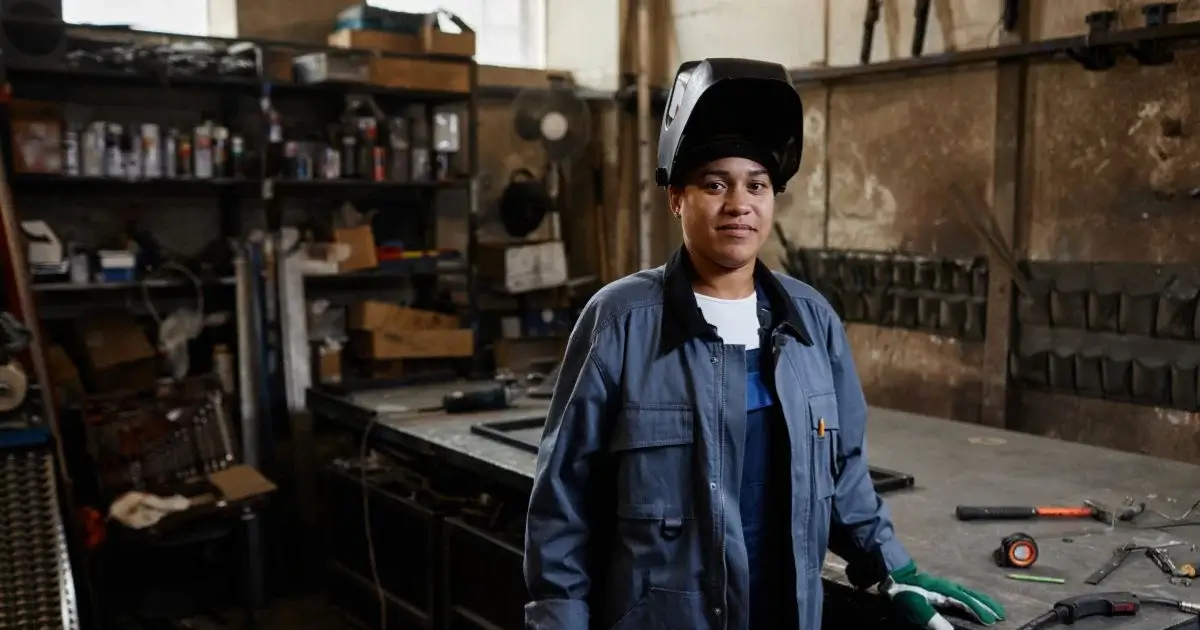
Portable fume arms parked beside downdraft tables are common enough in manual finishing cells that nobody questions the arrangement anymore. An operator repositions the arm by hand every time the part changes. The table was supposed to handle that station, and the arm exists because it doesn't, at least not for the taller work, and nobody has gone back to ask whether the geometry was wrong from the day it was specified.
Downdraft vs backdraft tables gets treated as a preference, or a budget call. It is neither, because the two arrangements move air in different directions, and direction decides whether an operation gets captured at all.
The Difference Is Direction, and Direction Is What Fails
Both get specified off the same short list: table size, airflow rating, filtration stages, footprint. That list never asks the one question that decides whether either arrangement works at the station.
A downdraft table draws air down through an open grid work surface into ducting below, while a backdraft table draws it horizontally across that surface into a plenum at the back. Capture happens when the contaminant is already traveling toward the intake, and it fails when the contaminant is traveling anywhere else.
Local exhaust is the preferred method of pulling welding fume out of a worker's breathing zone, and both arrangements qualify as local exhaust. Meeting the definition and doing the job are separate tests, and only the first one shows up on a purchase order.
Why Part Height Changes the Answer
A downdraft grid works because the contaminant is generated near the surface with an open path down through it, so set a large workpiece on that grid and the air routes around the obstruction instead of passing through it. Tall parts can close off the ventilation path entirely, or force air into fast pockets that pull at the shielding gas on a weld.
Distance finishes what the obstruction starts, since moving a capture point twice as far from the source calls for roughly four times the airflow to hold the same degree of control. Double the distance between the arc and the grid, and you have a different table, not a slightly harder-working version of the same one.
This is why a downdraft table not capturing fumes is rarely a horsepower problem, because the blower is still moving the air it was sized to move. The work moved away from the capture zone, and no amount of extra airflow buys that distance back at a price anyone will sign off on.
The paperwork usually agrees, because a ventilation assessment done at commissioning describes the operation that existed at commissioning. Add a taller fixture, a new clamping setup, or a second operation at the same bench, and that assessment now describes a station nobody works at anymore.
What a Downdraft Grid Handles Better Than Anything Else
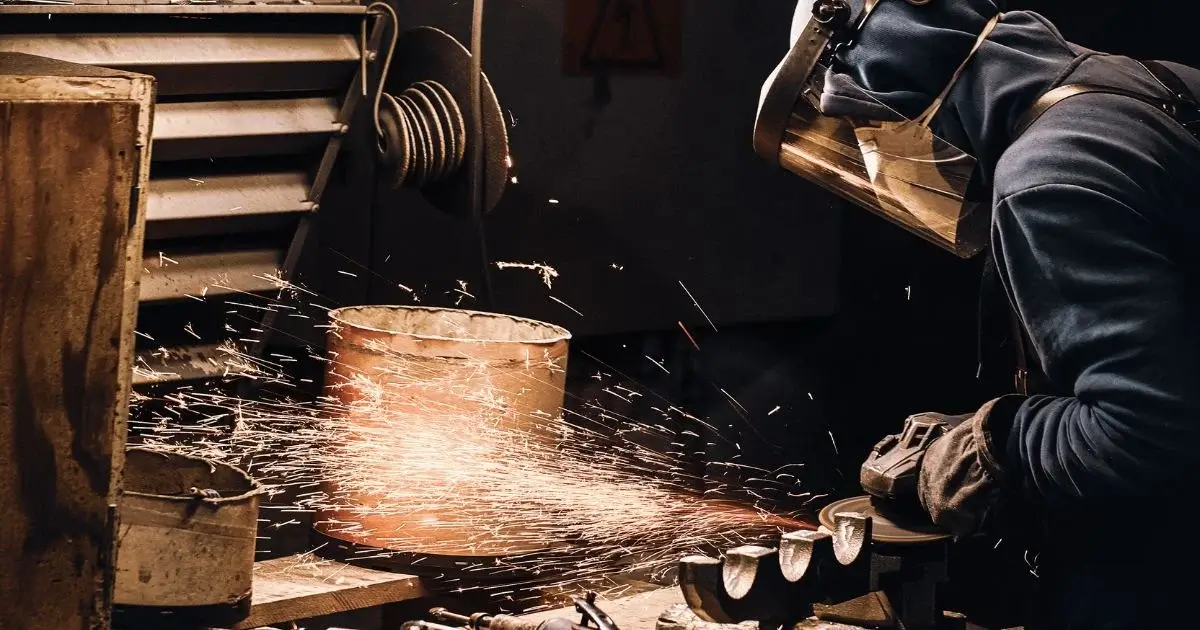
Grinding, deburring, and sanding throw particulate that is heavy, fast, and already headed downward or sideways at the surface. The operator's hands sit over the work, and the head sits above the hands. A downward pull moves that dust the way it was already going, away from the face, which is the cleanest version of source capture ventilation available for bench work.
Flat parts help further, because anything that sits low on the grid and stays put keeps the airflow path open across the whole surface. Grinding and sanding dust collection at a bench is close to the ideal case for a downdraft design, and it is why the style dominates manual deburring cells across metal fabrication.
The limit shows up with fine finishing dust that hangs rather than falls. Respirable dust from abrasive finishing stays up long enough to drift sideways before the grid gets it, especially on a wide table where the operator works near the front edge.
Where Rear Capture Earns Its Place
Welding fume leaves the arc hot, and hot air rises, so a flat grid is asking that plume to reverse its own buoyancy on the way to the intake. A rear plenum asks it to keep doing what it is already doing, then turns it away from the operator instead of drawing it past them.
That geometry is why rear or side draft belongs on tall fixtures, on work clamped vertically in a vise, and on seated operations like soldering where the face sits close to the joint. None of those put the contaminant down on the work surface, which is the one thing a grid needs.
Rear capture is a configuration rather than a separate purchase, because a bench set up as a welding fume extraction table can carry rear and side draft alongside the grid while the station next to it runs downdraft alone. Cells that weld at one position and deburr at the next rarely want the same capture direction twice.
The honest limit is capture depth, because a rear plenum works over a shallow zone and stops working the moment the work drifts forward on the bench. Operators put parts where the reach is comfortable, not where the plenum is, and a table that runs on operator discipline eventually stops running.
The Rule That Decides Downdraft vs Backdraft Tables
Hood design comes back to one principle that outranks the rest. The operator should never stand between the contaminant source and the intake. Walk a finishing cell holding that one rule, and the marginal installations point themselves out.
With a downdraft grid, the operator is above the intake, and the work sits between them. That arrangement is correct as long as the contaminant travels down. With rear capture, the intake sits behind the work, and the operator stands in front, and that one is correct as long as the contaminant carries backward or upward.
Each is right until the contaminant changes direction, and what changes it is part height, part temperature, tool orientation, and how the operator holds the piece. None of that shows up on a spec sheet, and all of it is visible in ninety seconds of standing at the bench.
The Cross-Draft Nobody Put on the Spec Sheet
Capture velocities at a bench are modest by industrial standards. The air speed a still-air capture zone works with is roughly what you produce breathing out gently across your palm, so very little competing air movement is needed to beat it.
Room air currents, forklift traffic, an overhead door in August, and the operator's own movement all compete against capture velocity. The worst offender is usually a spot-cooling fan, aimed at a welder by the welder, installed six months after the ventilation assessment passed.
Rear capture loses this fight faster, because its path runs horizontally and sits exposed across the front of the bench, while a grid has the part and the work surface partly shielding its path. Neither survives a fan aimed at the work, which is worth knowing before either arrangement takes the blame for a reading that came back high.
When Neither Configuration Is Enough
Some operations disqualify an open bench in either direction. Heavy contaminant generation, highly toxic dust, or contaminant thrown at real speed all point toward partial enclosure, because an enclosure surrounds the source instead of reaching for it. The same recommendation applies to any station sitting in persistent cross-draft conditions.
Enclosures cost more, take longer to engineer, and eat more floor space. Facilities resist them for those reasons before spending two years chasing exposure readings on an open bench that was never a defensible choice.
Filter loading splits the two directions as well. A grid takes the heavier fraction straight into the plenum below, where gravity does part of the collection work before the media ever sees it. Rear capture pulls the lighter, hotter fraction that never reached the surface at all, so filtration and service intervals do not transfer between them.
The distinction worth holding is between a station that needs capture and a station that needs containment. Deburring an aluminum bracket at a bench needs capture. Grinding hard facing alloys or finishing a coated weldment in a room with air moving through it, is a containment problem, and specifying a table for that is specifying the wrong equipment.
What Belongs on the Evaluation Instead
The airflow number is the last thing to settle, not the first. Before anyone quotes a table, the answers worth having are these:
The direction the contaminant leaves the work, and how fast
How tall the tallest part in the mix is, and whether it sits flat
Where the operator's head sits during the cut, the weld, or the pass
How often the part gets repositioned mid-operation
Everything else in that cell that moves air, including whatever nobody installed on purpose
One capture direction covering three unrelated operations is usually a compromise wearing the word standardization. What those cells want is the capture geometry that matches the contaminant at each position, which often means side draft added to a grid rather than a choice between two catalog products.
That is where industrial downdraft table systems built to the cell separate themselves, because filtration gets matched to the particulate profile, capture geometry gets matched to the work, and the blower gets sized to that geometry rather than the other way around.
If one table configuration is covering operations that don't share the same geometry, contact us. Our team can assess where the contaminant travels and where your operators stand before anything gets specified.