Your line cleaned those plastic housings an hour ago. The blow off looked good. But when those parts reach the paint booth, they're carrying dust that wasn't there before, and now you're chasing a contamination source that disappeared before anyone could find it.
This is what static-driven recontamination looks like in practice. The airflow removed the particles already on the part, but it didn't touch the charge pulling new ones in. And if you added a standalone ionizer bar upstream to handle that, there's a good chance it's not doing what you think it is.
Air knife ionization, integrated directly into your blow-off system, is different from an ionizer bar mounted nearby. The difference isn't subtle. It's the gap between controlling a problem and managing its consequences.
Why Static Defeats Cleaning When the Two Happen Separately
Cleaning and static neutralization need to happen at the same time, on the same surface. When they don't, one undoes the other.
An ionizer bar positioned near a blow off station generates ions and releases them into the surrounding air. Some reach the part. Some get absorbed by adjacent grounded equipment, frame members, or conveyor hardware before they make it.
Ions without a delivery mechanism don't reliably find their way to the part. They wander, get siphoned by adjacent grounded objects, or recombine with ions of opposite charge before reaching the target surface. The part gets cleaned by the airflow and charged by the friction of that same airflow moving through hoses and nozzles. It moves downstream carrying a fresh static charge.
By the time it passes the ionizer bar, the charge is already attracting particles from the ambient air. Clean it again and the cycle repeats.
What Standalone Ionizer Bars Actually Do Well — and Where They Fall Short
Bar ionizers work. In the right application, they're a practical and cost-effective tool. For webs of film and paper, where material passes directly under the bar at consistent distance and speed, they deliver ions reliably across the surface.
Production blow off is a different problem. Parts aren't webs. They're castings, housings, circuit boards, and machined components with varying geometries, moving at line speeds that may not allow sufficient dwell time for full neutralization.
When line speeds are high, a part may clear the ionizer bar before the charge has time to balance, and the surface exits with enough residual charge to immediately attract particles. Many bar ionizers also perform well within a few inches of the surface and drop off from there.
Surface charges on plastic and composite materials rebuild fast. In dry shop environments, that can happen within seconds of neutralization. If the ionizer bar treats the part at station three and the part reaches the coating booth at station seven, the charge that mattered for contamination control may have fully rebuilt by then.
How Integrated Static Bars Change the Delivery Problem
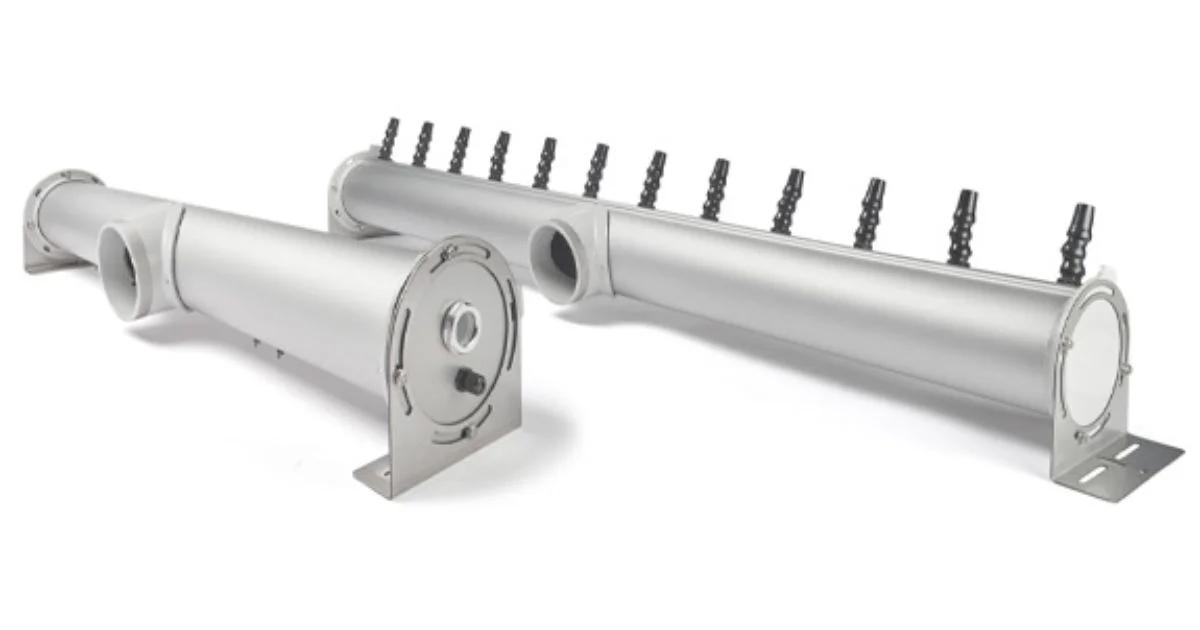
When a static bar is built into the air knife body, ions don't have to find their way to the surface on their own. The airflow carries them. The same laminar air sheet clearing particles from the part is also delivering ionized air blow off across that surface in the same pass.
This matters for geometry. A flat panel is easy — any ionizer can reach it. A plastic housing with recessed channels, snap-fit features, and internal corners is harder. The ionized airflow entering those recesses during blow off is the only ion delivery that consistently reaches that geometry. A bar mounted above or beside the part won't get ions in there reliably.
It also matters for timing. The contamination problem in electronics manufacturing isn't that parts are dirty when they leave the cleaning station. It's that they recharge and attract contamination on the way to the next one. Integrated air knife ionization neutralizes the surface during the airflow pass, so the part exits without a charge to attract anything.
The Compressed Air Problem Nobody Talks About
If your current blow off is compressed air with an ionizer bar somewhere in the system, there's a compounding issue worth examining. Compressed air moving through hoses, fittings, and nozzles generates static charge.
Particulate matter in the airstream contacts surfaces and builds charge as it moves through. You may be neutralizing with the ionizer bar while the blow off itself is recharging the surface, and because those two things happen close together in the line, the connection rarely gets made.
Blower-based systems don't eliminate static generation entirely, but they don't carry the same triboelectric contribution that compressed air does. They also deliver lower-velocity, higher-volume airflow that works with static bars rather than against them. The laminar profile from a properly designed air knife carries ions across the surface without scattering them.
What It Means for Coating and Painting Lines
In coating applications, the sequence matters more than most people give it credit for. Parts pick up static from conveyor movement, from handling, and from friction during pre-treatment. That charge attracts airborne dust and fibers between the cleaning station and the booth.
By the time the part reaches the gun, it may carry more contamination than it started with. The relationship between static control and coating quality isn't just about pre-cleaning. It's about keeping the surface neutral from the last cleaning step all the way through application.
That requires ionization at the blow off stage. Not upstream, not downstream, but as part of the same air delivery event that's removing particles. Treating it any other way means chasing a symptom after it's already done damage. Static control integration at the blow off stage is what keeps that from happening.
Ion Balance and Why It Matters for System Design
One point that gets skipped in the add-on approach: ionizer performance depends on ion balance. An ionizer producing more positive ions than negative ones doesn't neutralize — it shifts the charge. Residual imbalance means the surface isn't neutral.
The ESD Association notes that charged surfaces attract and hold contaminants, making particle removal difficult — and that many components are susceptible to damage at less than 100 volts. Holding ion balance over the operating life of the emitter points requires maintenance and monitoring.
When ionization is built into the blow off system from the start, a balance is specified for the application. Emitter maintenance becomes part of the plan rather than an afterthought. Facilities that bolt ionizer bars onto existing equipment often find that emitter fouling and balance drift go unnoticed for months, quietly degrading static control while contamination problems get blamed on other variables.
By the time someone identifies the ionizer as the source, the quality impact has been running for a full production cycle or longer.
The Actual Cost of Getting the Sequence Wrong
A line reworking defects traced to ESD contamination isn't losing just paint and labor. It's losing throughput at the rework station, holding time for parts in queue, and the scheduling delays that compound from there.
Most facilities don't track that fully because contamination-related defects land in quality metrics, not energy or maintenance budgets. They're diffuse. Hard to pin directly to a static control gap. That's part of why the add-on approach persists. It looks like a fix, and the failure mode when it underperforms is hard to separate from other quality noise.
Facilities that moved to properly integrated ionization systems see measurable results. Industry reporting in Semiconductor Digest found that wafer fab users reported reductions of 50 to 90 percent in particles attracted to surfaces after switching to properly delivered ionization. It's the difference between a static control system that works and one that checks a box.
What to Look for in a Properly Integrated System
When air knife ionization is engineered in from the start, the system accounts for emitter placement relative to the airflow path, ion delivery across the target geometry, and maintenance access to keep emitter points clean and balanced. Air knife lengths can run from 6 inches to over 240 inches, carrying ion delivery across the full part width in a single pass, with no gaps from mounting compromises.
The right question when evaluating any setup isn't whether ionization exists somewhere in the line. It's whether ionization and blow off are happening at the same moment, on the same surface, with airflow that reaches the full part geometry. A standalone bar mounted nearby may check the box without solving what keeps recurring.
Getting the Engineering Right Before the Line Runs
Most facilities add static control after contamination problems reach the point where someone has to address them formally. By then, the blow off system is already installed; the line is running, and ionization gets bolted on wherever it fits. That approach limits what's possible and leaves geometry and timing compromises baked in.
Specifying air knife ionization as part of the blow off design before installation is where geometry, ion delivery, airflow profile, and maintenance access can all be worked out together. It's a cleaner decision than retrofitting a system that wasn't built for the job.
For coating and paint line applications, getting this right before the line runs is the difference between a system that performs from day one and one that gets patched for years.
If your blow off is leaving static-driven contamination in the line, or you're planning a new system and want ionization that performs, contact us.
Our engineering team can assess your part geometry, production environment, and contamination points, and design a system where the ionization and the blow off work as one.