
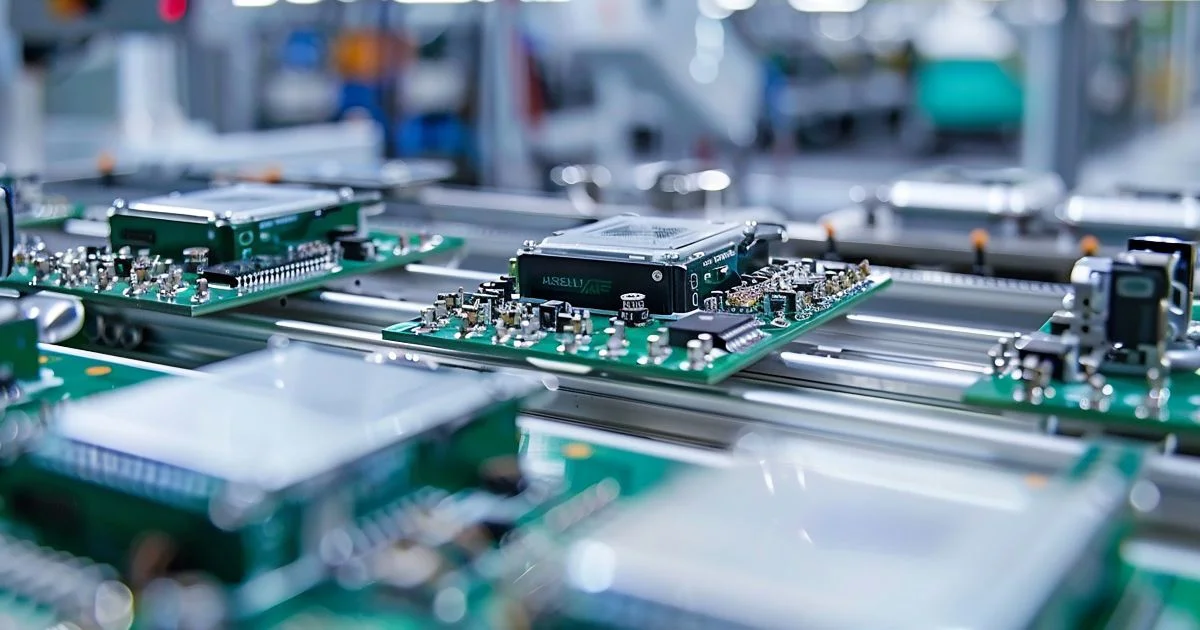
Walk enough electronics assembly lines, and the same pattern shows up: a board gets cleaned, passes inspection, and then collects a fresh layer of fine particulate. Nobody touched it; the room was filtered, and the contamination came back anyway.
The air is moving plenty of particulate, but what it isn't doing is addressing why the dust keeps finding its way back to the same board.
One camp runs anti-static blowers and bets on airflow, while the other mounts ionizing bars above the line and bets on killing the charge. Both camps are half right, because each one leaves the other half of the failure sitting on the board.
How Static Buildup on Circuit Boards Behaves
A bare board is an insulator, and that single fact drives everything that follows. An insulator holds onto a charge that grounding cannot pull off, and the EOS/ESD Association is blunt about why: insulators by definition cannot lose their electrostatic charge through connection to ground. You can bond every conductive surface at the workstation to a common ground point, and the board itself will still sit there holding its charge.
A charged board behaves like a magnet because synthetic clothing, a part sliding out of an insulating tray, or the friction of the line can all deposit charge on the surface. That charge then reaches out and pulls airborne particulate straight back down onto the board. So, the technician who just cleaned that board didn't fail at the job, because the board re-contaminated itself.
Why Anti-Static Blowers Move the Particle but Leave the Charge
Moving air is good at relocating loose particulate, but it is not good at neutralizing a static field that keeps pulling the next layer of dust down. Blow a charged board clean, and you may have won a few seconds, because in a dry plant, the surface charge rebuilds quickly and the board starts collecting again.
Worse, the wrong air source can add charge rather than remove it, since compressed air drawn through hoses and nozzles generates its own static through friction. We have seen lines where the cleaning step made the static problem worse, and the blower was never the villain, because the assumption that moving air equals clean failed.
So anti-static blowers do useful work, since they clear loose particles and avoid the friction charging that compressed air introduces, which, where charge isn't the real driver, is enough. The trouble starts when the charge is the driver and airflow is the only tool in the cell.
Why Ionizing Bars Kill the Charge but Move Nothing
An ionizing bar floods the area with balanced positive and negative ions. The charged board attracts the polarity it needs, the surface charge neutralizes, and the magnet switches itself off. The ESD Association describes air ionization as the standard way to neutralize charge on exactly these insulated, isolated objects, so for the charge problem, this is the right physics.
But an ion cloud does not push anything, so the particulate already sitting on the board stays where it landed. Neutralize a board covered in settled debris, and you get a clean-charged board that is still dirty, because nothing has cleared what was sitting there before the bar switched on.
There is also a placement reality, because a bar bolted above a line only neutralizes the zone directly beneath it. But boards carry components at different heights, with recessed connectors and shadowed pockets, and those low spots don't always experience the same ion exposure as the flat-top surface does. Coverage on a drawing and coverage across a three-dimensional assembly are not the same thing in practice, and the spots the ions miss are usually the same recessed pockets the airflow misses, too.
The Comparison Nobody Frames Correctly
Put the two failure modes side by side, and the versus falls apart: the blower clears particulate but leaves the charge that pulls it back, while the bar clears the charge but leaves the particulate. Run either alone against a charged-particle problem, and you fix one half while the other half undoes your work.
This is the part that costs facilities real money, and PCB contamination control is never only about yield at the cleaning station itself. ESD damage rarely announces anywhere near where it happened. A board picks up a charge, takes a hit that doesn't quite kill it, then passes the test, ships out, and fails in the field months later as a warranty return that nobody can trace.
ESD losses at affected operations have been pegged at 4 to 8 percent of annual revenue, with some internal studies reaching 10 percent or higher. Most of that figure is never the scrapped board itself — it is the rework, the field service calls, and the customer who stops calling altogether.
Why Dry Air Makes the Choice Show Up Faster
Humidity is the quiet variable underneath this argument, and it changes which camp looks correct. Moisture in the air gives surface charge a path to bleed off, so a board in a humid plant can shed enough charge that airflow alone looks like it is working. Drop the humidity, and that path closes; the charge builds faster, and it holds on the surface far longer than it did before. Winter is when the gap between the two camps stops being theoretical.
This is the reason the same line that ran clean all summer suddenly starts rejecting boards in January, even though nothing about the equipment changed.
The air dried out, the surface charge stopped dissipating on its own, and the blow-off that had been riding on ambient humidity got exposed. Cleanrooms see a version of this year-round, since the controlled environment strips out much of the humidity. In a cleanroom, many of the usual grounding and dissipative materials cannot be used, and the ESD Association notes that ionization is sometimes one of the only static control methods available there.
A plant weighing a blower against a bar in July may reach a different conclusion than it would in February. If that decision gets made during a humid stretch, an airflow-only setup can look sufficient right up until the season finally turns on it. That is worth factoring in before committing to one approach based on how the line behaves on a good day.
What Static Control in Electronics Assembly Requires
The honest answer is that these two functions were never competitors, because they are two halves of one job. The charge has to be neutralized, and the loose particle has to be carried off, in the same pass and over the same surface, or the board quietly re-contaminates itself somewhere between stations.
That is the logic behind building an ionizing bar directly into the air knife itself, rather than running them as separate equipment. The air knife lays down a continuous sheet of moving air that carries particulate off the board, and the ionizing bar rides in that airflow, so charge and particulate clear together in one pass. Because the ionized air follows that airflow into the lower areas of the assembly, it narrows the coverage gap a fixed overhead bar leaves behind.
One boundary is worth stating plainly here, because overselling the idea would be a mistake. An ionizing air knife is not by itself a whole ESD program, and the standards bodies are clear that ionization is one element sitting alongside grounding, wrist straps, dissipative work surfaces, and proper packaging.
What the integrated unit solves is the specific charged-particle problem at the cleaning or drying step, closing the recontamination loop that neither a standalone blower nor a standalone bar can close on its own. The rest of the protected area still has to do its own job.
How To Tell Which Problem You Have
Before specifying anything, the first move is figuring out which half is driving your defects, because that answer changes what you need to buy. If boards come off the line clean and stay clean, airflow may be all the application is asking for, but if they re-contaminate within seconds of cleaning, charge is somewhere in the picture.
A few questions sort it quickly. Does contamination come back almost immediately after cleaning, or does the board hold its finish? Are failures showing up downstream or in the field? Is the plant dry, especially in winter when humidity drops and charge builds faster?
Are you running compressed air at that cleaning step and adding the charge you are trying to clear? The pattern in those answers tells you whether you are dealing with a particle problem, a charge problem, or the combination that needs both handled at once.
So, the real decision was never blower or bar, because ESD control in electronics manufacturing means recognizing that a charged-particle problem needs both functions working in the same place. Most of the confusion comes from treating a two-part problem as a one-part purchase.
Not sure whether you've got a particle problem, a charge problem, or both? That's worth sorting out. Walk us through what you're seeing on your line, and our team can help you tell the two apart and show you where the charge and the particulate are meeting in your process.