
Most facilities respond to dust on parts by adding air. More nozzles, higher pressure, another blow off station before the booth. On charged materials, more air can make things worse.
Compressed air moving through hoses and fittings generates charge on its way to the part. The blow off removes particles and re-charges the surface in the same pass. Anti-static blowers exist because velocity alone was never the fix for contamination that keeps coming back.
What an Anti-Static Blower Actually Does Differently
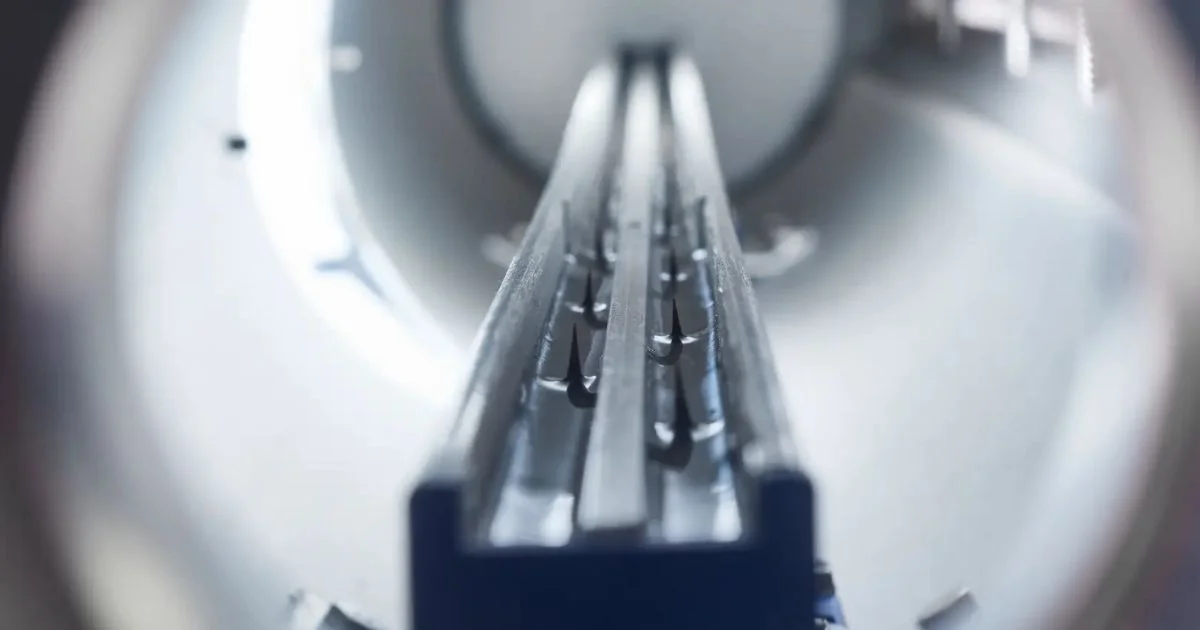
An anti-static blower moves air and neutralizes surface charge in a single pass. The air delivery comes from a blower rather than a compressor. Ionizing emitters sit inside the air knife body, so the airstream carries ions onto the part while it clears debris.
That pairing does more than either piece on its own. A charged surface grips particles against the air trying to lift them off. Contaminants cling to charged surfaces and resist removal, which is why increasing pressure rarely resolves a recurring contamination problem. Neutralize the surface, and ordinary airflow clears the part.
If your current setup treats cleaning and static as separate stations, the sequence is working against you.
How This Differs from a Fan with an Ionizer Bar
A standalone bar mounted near the line treats whatever passes directly in front of it. Coverage depends on where the bracket happened to fit, and on how fast the part travels past it.
Ion output also has a working range. Bars perform within a short distance of the surface and fall off past that. Mounting compromises made during installation quietly set the ceiling on performance.
A compressed air nozzle with static control added downstream has a different problem. That arrangement puts the charge generator and the charge neutralizer in the same process, working against each other.
The distinction that matters is whether neutralization and particle removal happen at the same moment, on the same surface. Everything else treats one symptom and hopes the other resolves on its own.
Where the Charge on Your Parts Comes From
Charge builds whenever two unlike materials make contact and then separate. That describes a conveyor roller, a fixture, a glove, and a part sliding into a rack. None of them register as a problem individually, and all of it accumulates.
Line speed changes the math. Faster separation between surfaces generates more charge, so the process changes that raised throughput also raises your contamination risk.
Compressed air adds to the total. Air moving through hoses, fittings, and nozzles accumulates charge, and airborne particulate contacts surfaces along the way. The station meant to clean the part can leave it holding contamination more tightly than before.
Dry air makes every part of this worse. A charge that would bleed off in humid conditions holds far longer through winter. In dry plants, contamination defects often climb from December through March, and the season rarely gets connected to the cause.
That seasonal pattern is often the clearest evidence a facility has that static, not airflow, is the limiting factor.
Why Static Shows Up in Quality Metrics Instead of Maintenance Logs
Nothing breaks when static control underperforms. Parts move, the blower runs, and the line holds rate. The failure appears two stations later as dirt in finish, an inclusion, or a mislabeled container.
Rework tickets record the defect, not the mechanism. The charge rebuilt somewhere between cleaning and coating, so the evidence is gone before anyone inspects the part.
That accounting gap is why static problems continue for years without formal correction. The cost lands in quality budgets, spread across enough part numbers that no single line looks bad enough to investigate.
The number that would justify a correction never gets quantified, because nobody owns the calculation. Quality tracks defects, maintenance tracks equipment, and the static gap sits between the two.
Static Control in Electronics Manufacturing Has Less Room for Error
Static control in electronics manufacturing carries a second failure mode on top of contamination. A charge that pulls dust onto plastic housing can destroy a device on a populated board. Many devices are damaged below 100 volts, far under what a person can feel.
Latent damage is the harder version to catch. The part survives assembly, passes functional testing, and fails in the field months later. Warranty data almost never traces back to the handling step that caused it.
Medical device and cleanroom assembly occupy similar territory. Particulate limits are tight, and a charged surface holds exactly the particles the specification excludes.
Contamination and static tend to be treated as separate programs on electronics lines, with separate owners and separate budgets. The blow-off station is one of the few places where both can be addressed in the same operation.

Static Buildup on Plastic Parts Rebuilds Faster Than Your Line Moves
Plastics and composites hold charge because they don't conduct it away. Static buildup on plastic parts can return within seconds of neutralization when the air is dry.
That timing decides whether a static control setup works at all. A bar might neutralize the part at station three while the booth sits at station seven. The charge can be fully back before the gun fires, and the reading at station three still looks clean.
Geometry makes the timing problem harder. A flat panel is easy to treat from almost any direction. A housing with recessed channels and internal corners needs ions carried into those areas by the airflow itself. That delivery problem is the argument for ionization built into the air knife rather than mounted beside it.
Where These Systems Earn Their Place on a Line
Coating and paint lines surface the problem fastest, because the defect is visible, and the rework cost is immediate. Parts pick up charge during handling and pre-treatment, then collect airborne fiber on the way to the booth.
Packaging and labeling lines run into a different version. Charged containers attract dust that interferes with label adhesion, and static generates handling failures at production speed. The rejection gets categorized as a labeling defect rather than a static problem.
Automotive interior parts combine both problems. Molded trim carries charge out of the tool and collects fiber in transit. It then enters a bonding or coating operation that assumes a clean surface.
Molding operations see it earliest, since parts leave the tool already charged. Electronics assembly, medical device work, and any line running plastic film or sheet stock end up in the same category.
Dust-heavy areas add a safety dimension. A static discharge near an ignitable dust or vapor concentration is a recognized hazard, not a theoretical one. Facilities operating in classified zones need non-sparking construction specified alongside the ionization.
Why the Air Source Matters as Much as the Ionizer
The air source changes what the ionizer has to overcome. Compressed air arrives at high pressure and low volume, with turbulence that scatters ions before they reach the surface. A blower delivers higher volume at lower pressure, and that laminar sheet carries ions across the part.
Operating costs separate them further. Compressed air can run seven to eight times the cost of blower air for equivalent blow off performance. Leaks alone waste 20 to 30 percent of what a compressor produces. Almost none of that cost gets assigned to static control.
A direct drive blower system also eliminates belts from the maintenance picture. Nothing slips; nothing needs retensioning, and delivered airflow stays where it was set. Ion delivery depends on the air behaving the same way every shift. That consistency is worth more here than on a straight drying application.
What to Ask Before You Specify an Ionized Air Blow Off System
Anyone quoting an ionized air blow off system should address several considerations before pricing it.
They should identify where the charge is generated in your process, not just where it gets measured. They should be clear about whether neutralization happens during the blow off pass or at a separate station. They should account for the recessed geometry on your specific parts, since that is where contamination sits.
Emitter maintenance is the requirement that gets overlooked most often. Emitter points foul over time and ion balance drifts. Static control degrades quietly while defects get blamed on other variables.
A supplier working from your process rather than a catalog will raise those points without being asked.
Specifying It Before the Line Is Built
Most static control gets added after contamination problems become formal enough that someone has to own them. By then the blow off system is installed, the line is running, and ionization goes wherever it physically fits. Those compromises get built permanently.
Building static control into the original blow-off design changes what's possible. Airflow, ion delivery, part geometry, and maintenance access get worked out together. Air knife lengths can run from 6 inches to over 240 inches. Coverage across the full part width doesn't depend on stacked hardware.
That decision usually clears in one budget cycle. The line then runs on that choice for the life of the system. The window to get ion delivery right is earlier than most teams expect.
If parts keep picking up dust between your cleaning station and the next operation, contact us. Our team can look at where the charge is being generated and what your current setup is missing.